













The Vacuum Tube Enclosure (Tube Envelope) in Diagnostic X-Ray Tubes

The vacuum tube enclosure (often referred to as the glass or metal-ceramic envelope) is the primary structural vessel of a diagnostic X-ray tube. It houses the internal functional components—specifically the negative electrode (cathode assembly) and the…
Protective Housing & Cooling System in X-Ray Tube: Everything You Need to Know
The generation of diagnostic X-rays is one of the most energy-inefficient processes in applied physics. During exposure, approximately 99% of the kinetic energy of bombarding electrons is converted directly into waste thermal energy, with less than 1%…
Line-Focus Principle in X-Ray Tube: Working Principle, Formula & Diagram
The Line-Focus Principle is a foundational geometric design innovation in diagnostic radiology. It addresses the central paradox of X-ray target design: how to minimize the spatial size of the X-ray source to produce high-resolution medical images while…
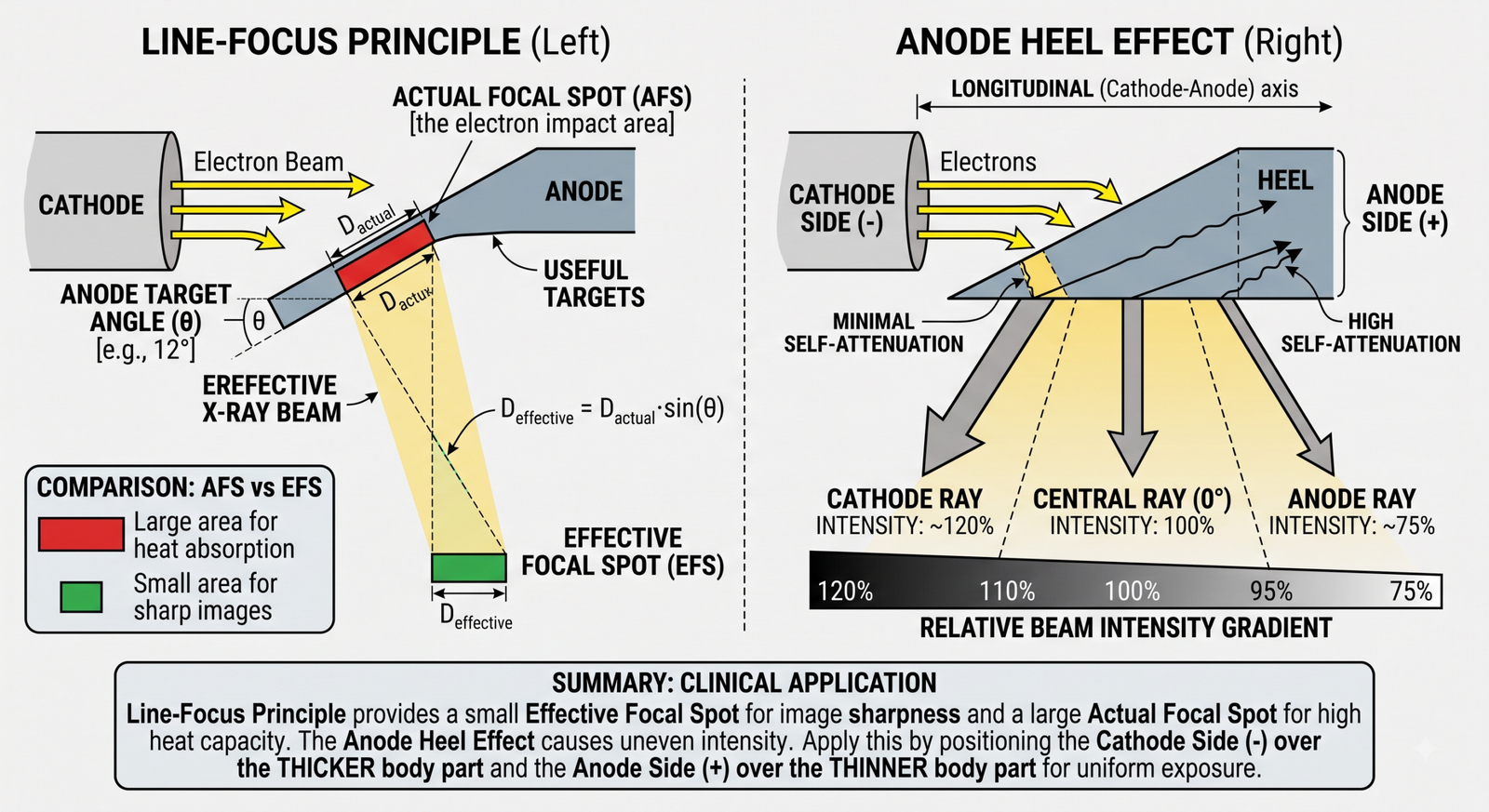
Anode Heel Effect in X-Ray Tube: Physics, Factors & Clinical Applications
The Anode Heel Effect is an inherent physical phenomenon in diagnostic X-ray tube assemblies. It refers to the variation in radiation intensity along the longitudinal (anode-to-cathode) axis of the primary X-ray beam. Specifically, the beam intensity is…
Off-Focus Radiation Explained: Causes, Image Fogging & Prevention
Off-focus radiation (also known as extrafocal radiation) refers to X-ray photons produced outside the designated focal spot on the target track of an X-ray tube assembly. While ideal X-ray tube design dictates that high-velocity electrons interact…
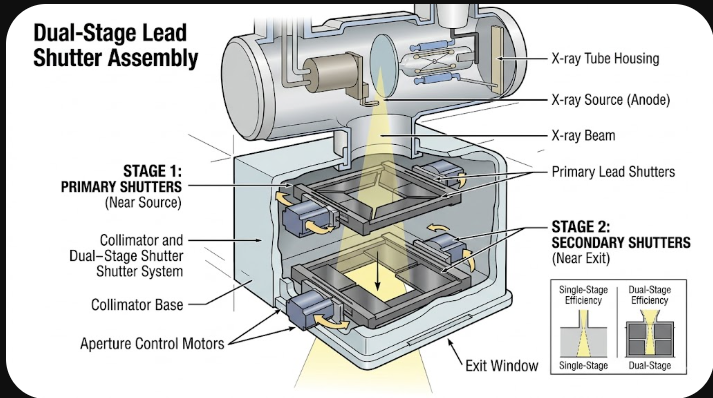
How X-Ray Collimators Work: Beam Shaping, Optics & Scatter Reduction
In diagnostic radiography, controlling the primary X-ray beam is a fundamental requirement for achieving high-contrast images and ensuring strict radiation protection. Unrestricted X-ray beams irradiate tissue outside the clinical area of interest,…
Complete Guide to Rectifiers: Half-Wave, Full-Wave & Bridge Circuits
Rectifiers are electrical circuits that convert Alternating Current (AC), which reverses direction periodically, into Direct Current (DC), which flows in only one direction. This process is known as rectification. 1. Core Principle of Rectification…
Rectification in an X-Ray Circuit
Rectification in an X-Ray Circuit: This is the electrical process of converting high-voltage Alternating Current (AC) from the step-up transformer into Direct Current (DC). This ensures an uninterrupted, unidirectional stream of projectile electrons…
Filament Circuit in X-Ray Tube
Filament Circuit in X-Ray: The filament circuit is a dedicated sub-circuit within the X-ray generator designed to deliver low voltage and high current to heat the tungsten filament in the cathode. This process produces free electrons via thermionic…
Kilovoltage (kVp) Control Circuit in X-Ray
Kilovoltage (kVp) Control Circuit: The kVp control circuit (or primary high-voltage circuit) regulates the primary voltage delivered to the step-up transformer in an X-ray generator. It directly sets the peak potential (40 to 150 kVp) across the X-ray…