

The Tube Envelope and Housing-
The Envelope-
The envelope must be strong enough to withstand atmospheric pressure, resistant to the considerable amount of heat produced by the anode and able to transfer this heat away efficiently. Historically, it was constructed from thick-walled borosilicate glass under very clean conditions to a high precision so as to provide adequate insulation between the cathode and anode. The X-rays were emitted through a thinner glass window.
In modern tubes the envelope is frequently metal-walled. These tubes are more compact, have greater mechanical stability, have ceramic material to provide better electrical insulation between the anode/cathode connections and have good absorption of X-rays not passing through the window—now beryllium or titanium. They are also more efficient heat exchangers because of a high absorption coefficient for radiation on the vacuum side and good conductivity.
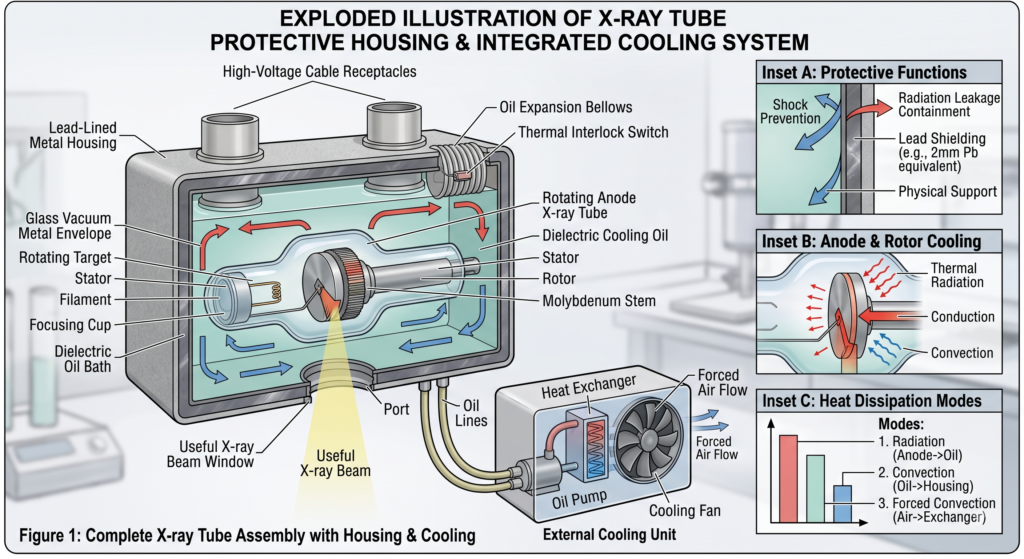
The envelope also provides a vacuum seal to the metallic components that protrude through it. Great care must be taken at the manufacturing stage to achieve a very high level of vacuum before the tube is finally sealed. The electrons have a mean free path of several metres . If residual gas molecules are bombarded by electrons, the electrons maybe scattered and strike the walls of the envelope, thereby causing reactions that result in release of gas molecules and further reduction of the vacuum.
The presence of atoms or molecules of gas or vapour in the vacuum, whatever their origin, is likely to have a deleterious effect on the performance of the tube. For example, metal evaporation from the anode can cause a conducting film across a glass envelope, thereby distorting the pattern of charge across the tube. This can change the output characteristics since it is assumed that the flow of electrons from cathode to anode will be influenced by the repulsive effect of a static layer of charge on the tube envelope. If this charge is not static, the electrons in the beam are not repelled by the tube envelope and deviate to it. This diversion of current may significantly reduce tube output. Metal enclosures repel ion deposits so they are less susceptible to build-up of tungsten ions from tungsten vapour. They also collect electrons scattered from the anode, thereby reducing extrafocal radiation . Both residual gas and anode evaporation cause a form of tube instability which may occasionally be detected during screening as a kick on the milliammeter as discharges take place. In the extreme case, the tube goes ‘soft’ and arcs over during an exposure.
Borosilicate Glass versus Metal/Ceramic Envelope-
Glass tubes are more likely to break during manufacture and it is difficult to adjust mechanical tolerances inside the glass housing. However, they are cheaper and so are still used for standard applications, that is, radiography with smaller power demands. Metal/ceramic envelopes allow better mechanical precision, less manufacturing wastage and can resist larger mechanical stress. The stress tolerance is particularly important in CT and fastmoving 3D imaging in angiography.
The Tube Housing-
This has various functions which may be summarised as follows:
• Shields against stray X-rays because it is lined with lead—leakage must not exceed 1 mGy in 1 h at 1 m
• Provides an X-ray window—which filters out some low energy X-rays
• Contains the anode rotation power source
• Provides high voltage terminals
• Insulates the high voltage
• Allows precise mounting of the X-ray tube envelope
• Provides a means for mounting the X-ray tube
• Provides a reference and attaching surface for X-ray beam collimation devices
• Contains the cooling oil
The advantages of filling this housing with oil are as follows:
(a) High voltage insulation.
(b) Effective conduction of heat from the X-ray inset tube.
(c) Since the oil expands, an expansion diaphragm can be arranged to operate a switch
when the oil reaches its maximum safe temperature.
