

Properties Of X Rays –
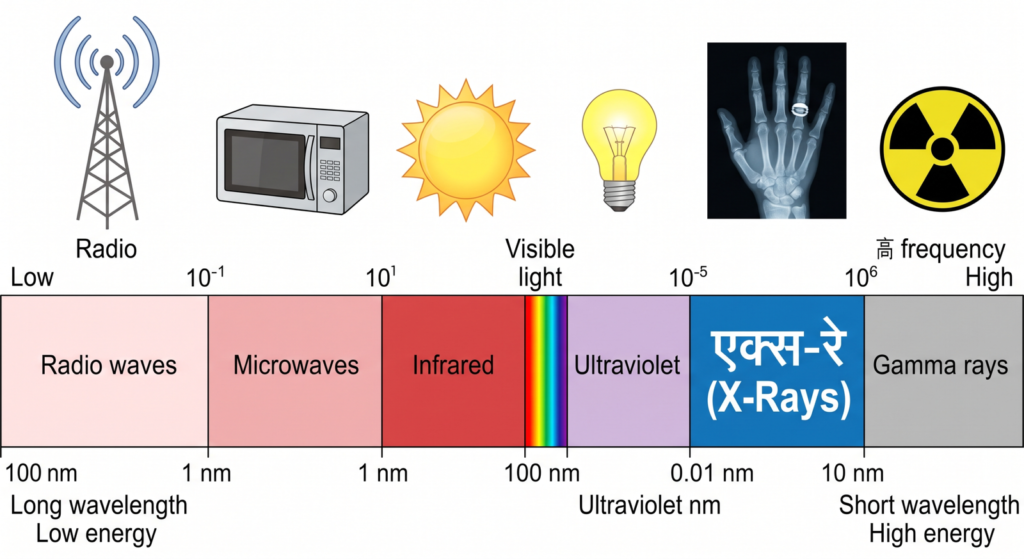
Wave Length – 0.01 to 10 nanometres
Frequency – 3 × 10¹⁹ Hz to 3×10¹⁶
Energy – 100 eV to 100 keV
Type – Their electromagnetic spectrum wavelength is shorter.
Production – When the electrons are accelerated to energies in excess of 5KeV and are than directed onto a target surface, X-rays may be emitted.
Penetration Power – X-rays have high penetrating power and travel several tens to hundreds of meters in the air. When they collide with the human body, they can reach deep into the body or sometimes pass through it. Their energy is imparted to the part they pass through.
Charge – They don’t carry an electric charge with them
Path Of Travel – Move in a straight path. They are able to move through a vacuum.
Speed – Travel with speed of light {So they travel at 299792458 metres per second (approximately 3.00×10 8 m/s)}
Effect Of X Rays –
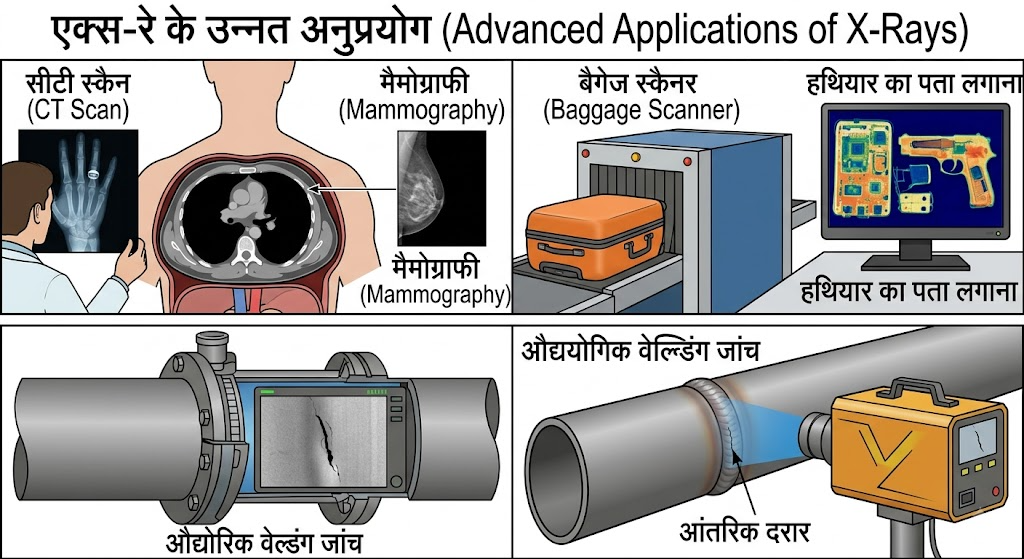
It will be helpful to briefly go over the pertinent effect of X rays since it is obvious that the intensity of an X-ray beam must be quantified in terms of the observable physical, chemical, or biological changes that the beam may induce. Two of them are basic enough to be categorised.
Primary Effect –
That is, measurements may be done independently of a reference beam.
- Heating effect
- Ionisation Effect
Heating effect –
Heating is the most straightforward result of radiation absorption. It might be claimed that the heating impact is minimal for ionising radiation with poor linear energy transfer. A tiny, spherical zone in which the energy deposit is isolatingly confined is called a spur and is produced by such low-LET radiation. Because of the random superposition of events that causes the heating process, the temperature rise, T, of the spur over the ambient temperature has a space-time dependency and, by hypothesis, a statistical distribution known as Gaussian.
Ionisation Effect –
In the diagnostic energy range, X-rays ionise any substance they pass through through photoelectric and Compton interactions. The importance of pair creation only increases with energy. Under usual temperature and pressure, a constant volume of ions will yield a set number of ions.
Secondary Effect –
Numerous other characteristics of X-rays can be employed for dosimetry and frequently are. However, in all these cases, the system must be calibrated by measuring its reaction to X-ray beams of known intensity, hence these are typically referred to as secondary attributes.
- Physical effects
- Physico – chemical effects
- Chemical changes
- Biochemical changes
- Biological changes
Physical effects –
Visible light is produced when certain materials and X-rays interact. When two substances interact, light may be released right away (fluorescence), later on (phosphorescence), or, in the case of some materials, only when heated (thermoluminescence).
Physico-chemical effects-
It is well-known and often utilised that X-rays have an effect on photographic film. The ionisation of the exposed silver bromide crystals in the emulsion layer prior to processing happens when photon energy from the patient emerges, resulting in the latent (invisible) picture generation. Electrons are knocked out as a result of the Compton and photoelectric interactions, which are the main interactions with the bromide crystals. As a result, when the radiograph is exposed, something physical effect happens.
Chemical changes –
Numerous organic substances undergo colour changes when exposed to X-rays. Some of the most precise indicators of the status of several chemical processes are provided by the presence or absence of colour. However, it frequently becomes hard to identify non-visible chemical changes of extremely tiny scale by any straightforward approach. Of course, many organic processes happen without colour changes. Additionally, a number of organic colours, dyes, and structurally similar substances are ingested by patients to make particular body sections more visible on an X-ray film.
When a substance like ferrous sulphate is exposed to X-rays because of their oxidising capabilities, some of the free ions that are created oxidise part of the Fe ++ to Fe +++ . By passing the solution via an ultraviolet light source, this transformation is easily visible. Fe ++ does not absorb this light, whereas Fe +++ does.
Biochemical changes –
Enzymes rely on the extremely exact form connected to their secondary and tertiary structure for their function. Since the precise distribution of electrons is crucial, excess free electrons introduced by ionising radiation easily inactivate enzymes.
Biological changes –
The main health risks from radiation exposure include cancer and genetic damage. Compared to a hereditary influence, cancer would be around five times more likely. Chromosome alterations, stillbirths, congenital disorders, and newborn and childhood mortality are examples of genetic consequences. A mutation in the cells of an exposed individual that is passed on to their offspring can cause these consequences. If the affected genes are dominant, these impacts may start to show virtually right away. If the genes are recessive, they can also arise several generations later. In principle at least, irradiating a suspension of bacteria followed by a survival test might give a type of biological dosimeter because X-rays have the ability to destroy cells and bacteria.