

X Ray Film-
X-ray film displays the radiographic image, X-ray films for general radiography are composed of an emulsion-gelatin containing radiation-sensitive silver halide crystals, such as silver chloride or silver bromide, and a clear, flexible, blue-tinted base. When an emulsion crystal is exposed to light, a silver ion (Ag+) and an electron are produced. The silver ion is drawn to the sensitivity specks by the electrons that become attracted to them. The silver ions then join together, forming clusters of metallic silver (black).
A radiation-sensitive emulsion is placed on a clear polyester foundation to create a contemporary x-ray film. Gelatin serves as the suspension medium for the silver halide grains in the emulsion, which is composed of silver halide crystals (usually composed of 95% silver bromide and 5% silver iodide).
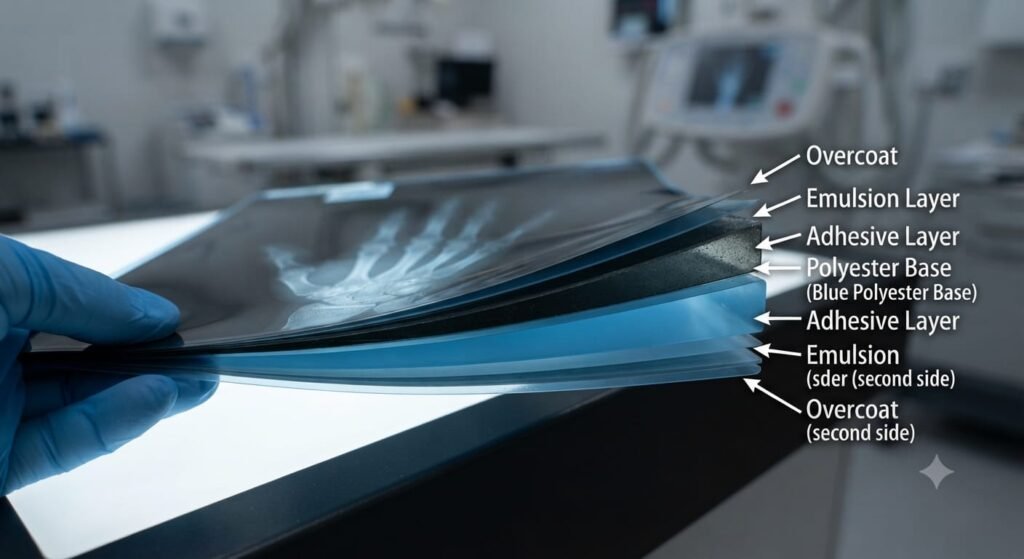
COMPOSITION OF THE X – RAY FILM
X ray film consist of 4 layers.
Film base-
- The foundation of the x-ray film, in the middle, is what holds up the thin photographic emulsion on both of its surfaces. The base should ideally be sturdy and flexible to allow for repeated snapping of the films into x-ray illuminators (Viewing boxes).
- It must also survive any geometric deformation brought on by the heat of the developing process, and the base must have an optical backdrop that is homogeneous and very transparent.
- It is made of polyester (polyethylene teraphthalate).
Properties of base layer-
- Thin (0.08–0.18 mm depending on nature of film)
- Strong and adaptable in order to endure the stress that film loaders and automation processors will subject it to.
- Because it is chemically inert, it has no effect on the processing solution or the delicate emulsion.
- Water-tight, to help speed up processing and reduce processing time
- For maximum light transmission, make sure the thickness is uniform.
Substratum or subbing layer-
- The base and the emulsion typically don’t stick together. This necessitates the use of a tiny coating of appropriate adhesive, to bond the emulsion to the film base.
- Typically, gelatin and the film base solvent are combined to create this layer.
- This layer may include a coloured dye to lessen the quantity of light that passes from one emulsion layer to the next, lessening the crossover effect.
The protective layer-
- Protecting the softer emulsion layers underneath it is the responsibility of the protective layer.
- The only thing keeping the film from being scratched while being handled, thin gelatin, protects emulsion from damage
- For filmmakers, shrinkage (after drying, which creates glassy protective layers) and dissolving in warm water are two crucial characteristics.
- The layer expands and absorbs the water when dissolved in cold water.
Emulsion layer-
- Small silver halide crystals and gelatin, which is generated from cadaveric bones, make up the X-ray film emulsion (grains).
- Gelatin acts as a matrix to maintain the grains of silver halide evenly spread and to prevent them from clumping.
- Without affecting the gelatin’s durability or strength, the developing and repairing solutions can quickly permeate the gelatin.
- The light-sensitive component of the emulsion is made up of tiny crystal grains of silver halide (1.0 to 1.5 microns in diameter).
- These grains, which go by the name silver-iodobromide, often contain 90 to 99% silver bromide and 1 to 10% silver iodide.
Type of X Ray film-
Type Of Film On The Basis Emulsion Layer-
Single sided emulsion film-
- The photosensitive emulsion is only coated on one surface of the film base in these kinds of x-ray films.
- These films are utilised with a single intensifying screen cassette, with the film being positioned in front of the screen, or on the side that faces the X-ray tube.
- When a better spatial resolution of the image is necessary, these films are utilised specifically for that purpose.
- It is used when just one intensifying screen is used, such as in mammography where a high resolution is essential and when a picture of a light source (such as a laser or photofluorographic light source) is needed.
Double-sided emulsion film-
- These general purpose x-ray films are used with double screen cassettes with the film sandwiched between the screens.
- They have photosensitive coatings on both sides of the base.
- Such films need shorter processing periods and less exposure.
- For instance, it is possible to create a picture in half the time it takes to create one using single-sided film.
- Advantage Of Double Coated Film-
- Reduced exposures allow for the use of shorter exposure durations, which may result in less patient movement.
- The patient receives a lower radiation dosage, and less scattered radiation is created. and less dispersion results in a safer workplace for employees.
- They also make it feasible to employ a smaller focus spot size, which lessens geometric unsharpness.
On the basis of use with intensifying screens-
Screens Films-
These films are used with intensifying screens, thus light, not X-rays, is eventually employed to expose them. Less exposure time and processing is needed for the radiographic picture development on these films. These films also have a thinner emulsion covering. These films are adaptable and utilised for the majority of general diagnostic radiography.
Non-screen films-
These films don’t employ intensifying screens and need longer exposure factors and processing time to provide radiographic densities that are on par with non-screen films’ radiographic densities. Since their emulsion is comparatively thicker, the radiographic images created on such films show great detail. Such films are employed for specialised objectives, such as the identification of tissue changes that are too delicate to be seen on a typical routine radiograph, such as hail-line fractures.
On the basis of film speed-
Handling and storage care of unexposed and exposed x-ray films
- 𝐇𝐞𝐚𝐭, 𝐡𝐮𝐦𝐢𝐝𝐢𝐭𝐲, 𝐚𝐧𝐝 𝐜𝐞𝐫𝐭𝐚𝐢𝐧 𝐜𝐡𝐞𝐦𝐢𝐜𝐚𝐥 𝐯𝐚𝐩𝐨𝐮𝐫𝐬 𝐦𝐚𝐲 𝐚𝐥𝐥 𝐛𝐞 𝐡𝐚𝐫𝐬𝐡 𝐨𝐧 𝐟𝐢𝐥𝐦 𝐞𝐦𝐮𝐥𝐬𝐢𝐨𝐧𝐬.
- 𝐔𝐧𝐞𝐱𝐩𝐨𝐬𝐞𝐝 𝐟𝐢𝐥𝐦 𝐬𝐡𝐨𝐮𝐥𝐝 𝐛𝐞 𝐤𝐞𝐩𝐭 𝐚𝐰𝐚𝐲 𝐟𝐫𝐨𝐦 𝐬𝐭𝐫𝐚𝐲 𝐛𝐚𝐜𝐤𝐠𝐫𝐨𝐮𝐧𝐝 𝐫𝐚𝐝𝐢𝐚𝐭𝐢𝐨𝐧 𝐢𝐧 𝐚 𝐜𝐨𝐥𝐝 (𝐛𝐞𝐥𝐨𝐰 𝟕𝟓𝐅), 𝐝𝐫𝐲 (𝐫𝐞𝐥𝐚𝐭𝐢𝐯𝐞 𝐡𝐮𝐦𝐢𝐝𝐢𝐭𝐲 𝐬𝐡𝐨𝐮𝐥𝐝 𝐛𝐞 𝐮𝐧𝐝𝐞𝐫 𝟔𝟎%) 𝐞𝐧𝐯𝐢𝐫𝐨𝐧𝐦𝐞𝐧𝐭 𝐛𝐞𝐜𝐚𝐮𝐬𝐞 𝐨𝐟 𝐭𝐡𝐢𝐬 𝐧𝐞𝐠𝐚𝐭𝐢𝐯𝐞 𝐞𝐟𝐟𝐞𝐜𝐭.
- 𝐅𝐢𝐥𝐦𝐬 𝐦𝐚𝐲 𝐛𝐞 𝐜𝐡𝐢𝐥𝐥𝐞𝐝 𝐟𝐨𝐫 𝐟𝐮𝐫𝐭𝐡𝐞𝐫 𝐩𝐫𝐨𝐭𝐞𝐜𝐭𝐢𝐨𝐧, 𝐡𝐨𝐰𝐞𝐯𝐞𝐫 𝐢𝐟 𝐭𝐡𝐢𝐬 𝐢𝐬 𝐝𝐨𝐧𝐞, 𝐭𝐡𝐞 𝐟𝐢𝐥𝐦 𝐦𝐮𝐬𝐭 𝐛𝐞 𝐫𝐞𝐭𝐮𝐫𝐧𝐞𝐝 𝐭𝐨 𝐫𝐨𝐨𝐦 𝐭𝐞𝐦𝐩𝐞𝐫𝐚𝐭𝐮𝐫𝐞 𝐛𝐞𝐟𝐨𝐫𝐞 𝐮𝐬𝐞.
- 𝐅𝐨𝐫 𝐝𝐫𝐲𝐢𝐧𝐠, 𝐭𝐡𝐞 𝐰𝐞𝐭 𝐩𝐫𝐨𝐜𝐞𝐬𝐬𝐞𝐝 𝐟𝐢𝐥𝐦 𝐧𝐞𝐞𝐝𝐬 𝐭𝐨 𝐛𝐞 𝐦𝐚𝐢𝐧𝐭𝐚𝐢𝐧𝐞𝐝 𝐮𝐩𝐫𝐢𝐠𝐡𝐭 𝐢𝐧 𝐚 𝐟𝐢𝐥𝐦 𝐝𝐫𝐲𝐞𝐫.
- 𝐓𝐨 𝐚𝐯𝐨𝐢𝐝 𝐥𝐞𝐚𝐯𝐢𝐧𝐠 𝐟𝐢𝐧𝐠𝐞𝐫 𝐩𝐫𝐢𝐧𝐭𝐬 𝐨𝐧 𝐭𝐡𝐞 𝐟𝐢𝐥𝐦𝐬, 𝐧𝐞𝐯𝐞𝐫 𝐜𝐨𝐧𝐭𝐚𝐜𝐭 𝐭𝐡𝐞 𝐰𝐞𝐭 𝐟𝐢𝐥𝐦𝐬 𝐰𝐢𝐭𝐡 𝐲𝐨𝐮𝐫 𝐟𝐢𝐧𝐠𝐞𝐫𝐬.
- 𝐁𝐞𝐜𝐚𝐮𝐬𝐞 𝐟𝐢𝐥𝐦 𝐞𝐦𝐮𝐥𝐬𝐢𝐨𝐧𝐬 𝐚𝐫𝐞 𝐚𝐥𝐬𝐨 𝐩𝐫𝐞𝐬𝐬𝐮𝐫𝐞-𝐬𝐞𝐧𝐬𝐢𝐭𝐢𝐯𝐞, 𝐭𝐡𝐞𝐲 𝐬𝐡𝐨𝐮𝐥𝐝 𝐛𝐞 𝐤𝐞𝐩𝐭 𝐨𝐧 𝐭𝐡𝐞𝐢𝐫 𝐞𝐝𝐠𝐞𝐬 𝐫𝐚𝐭𝐡𝐞𝐫 𝐭𝐡𝐚𝐧 𝐟𝐥𝐚𝐭.
- 𝐓𝐡𝐞 𝐮𝐛𝐢𝐪𝐮𝐢𝐭𝐨𝐮𝐬 𝐜𝐨𝐬𝐦𝐢𝐜 𝐫𝐚𝐝𝐢𝐚𝐭𝐢𝐨𝐧 𝐦𝐚𝐲 𝐛𝐞 𝐝𝐞𝐭𝐞𝐜𝐭𝐞𝐝 𝐮𝐬𝐢𝐧𝐠 𝐗-𝐫𝐚𝐲 𝐟𝐢𝐥𝐦. 𝐓𝐡𝐢𝐬 𝐫𝐚𝐝𝐢𝐚𝐭𝐢𝐨𝐧 𝐰𝐢𝐥𝐥 𝐦𝐚𝐤𝐞 𝐞𝐯𝐞𝐫𝐲𝐭𝐡𝐢𝐧𝐠 𝐟𝐨𝐠𝐠𝐲.
- 𝐓𝐡𝐞 𝐫𝐚𝐝𝐢𝐨𝐠𝐫𝐚𝐩𝐡 𝐝𝐚𝐫𝐤𝐞𝐧𝐬 𝐝𝐮𝐞 𝐭𝐨 𝐝𝐢𝐬𝐩𝐞𝐫𝐬𝐞𝐝 𝐫𝐚𝐝𝐢𝐚𝐭𝐢𝐨𝐧, 𝐞𝐱𝐩𝐨𝐬𝐮𝐫𝐞 𝐭𝐨 𝐥𝐢𝐠𝐡𝐭, 𝐨𝐫 𝐫𝐚𝐝𝐢𝐚𝐭𝐢𝐨𝐧 𝐞𝐱𝐩𝐨𝐬𝐮𝐫𝐞 𝐩𝐫𝐢𝐨𝐫 𝐭𝐨 𝐞𝐱𝐩𝐨𝐬𝐮𝐫𝐞.
- 𝐀𝐝𝐝𝐢𝐭𝐢𝐨𝐧𝐚𝐥𝐥𝐲, 𝐢𝐭 𝐦𝐚𝐲 𝐛𝐞 𝐛𝐫𝐨𝐮𝐠𝐡𝐭 𝐨𝐧 𝐛𝐲 𝐚𝐠𝐞 𝐨𝐫 𝐨𝐯𝐞𝐫𝐝𝐞𝐯𝐞𝐥𝐨𝐩𝐦𝐞𝐧𝐭.
Due to their greater exposure sensitivity, very high-speed films are more prone to fogging than slower emulsions.
Expiry Of Radiographic Film-
- Films should not be used after their expiry period.
- When the film boxes are made, an expiration date is written on them.
- Film should be bought in amounts that don’t require long-term storage in order to avoid surpassing the expiration date.
- The inventory of film should be rotated so that the older film is used first.
- No film that has beyond its “shelf life” date may be placed in salvage.