Advanced Technical and Mathematical Analysis of Gas-Filled Radiation Detectors

Gas-Filled Radiation Detectors represent the foundational technology of radiation measurement instrumentation, utilized extensively across diagnostic radiology, radiation therapy physics, nuclear engineering, and industrial safety compliance. Their universal adaptability stems from the fundamental interaction of ionizing radiation with gaseous media under controlled electrostatic fields.
1. Fundamental Gas-Ionization Mechanics
When ionizing radiation (such as alpha particles, beta particles, gamma rays, or X-rays) traverses the active gas volume of a detector, it deposits kinetic energy into the gas molecules through inelastic collisions.
Primary Ionization and W-Value: The transfer of energy results in the ejection of orbital electrons from neutral gas atoms, creating positive gas ions and free electrons. This energy required to create a single ion pair is defined as the -value (typically ranging between 25 to 35 eV per ion pair for common detector gases like air, argon, or neon, regardless of the incident radiation energy).
Drift Velocity and Ionic Mobility: Once formed, the liberated free electrons—having an extremely small mass—accelerate rapidly toward the positive electrode (anode) under the influence of the applied electric field. Conversely, the much heavier positive ions drift at a significantly slower velocity toward the negative electrode (cathode).
Recombination Dynamics: If the electric field strength is weak, a fraction of the positive and negative ions will collide and neutralize each other before reaching the electrodes, a phenomenon known as columnar or general recombination. To achieve accurate measurements, the applied voltage must be sufficient to sweep the charges apart before recombination occurs.
2. Comprehensive Voltage-Response Curve and Operating Regions
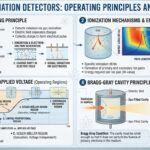
The operational characteristics of any gas-filled detector are determined entirely by the magnitude of the high voltage applied across its electrodes. The relationship between applied voltage and the resulting electrical pulse height (or ionization current) is categorized into six distinct physical regions:

Region I: Recombination Region (Zero to Low Voltage)
Mechanism: The electric field is weak. Charge collection is incomplete because the majority of primary ion pairs recombine into neutral atoms.
Detector Utility: No practical detectors operate in this region due to severe signal loss and instability.
Region II: Ionization Chamber Region (Saturation Plateau)
Mechanism: The electric field is strong enough to collect of the primary ion pairs before recombination takes place, but insufficient to impart enough kinetic energy to electrons for secondary ionization. The response curve forms a flat plateau.
Detector Utility: Ionization Chambers operate here. The measured current is directly proportional to the total ionization produced, making it ideal for measuring high exposure rates and radiation beam calibration.
Region III: Proportional Region
Mechanism: The applied voltage is elevated further, causing free electrons to accelerate between collisions. They acquire critical kinetic energy to knock out secondary electrons from neutral gas atoms, initiating a localized localized gas multiplication cascade known as an avalanche effect.
Detector Utility: Proportional Counters operate in this zone. The final output pulse magnitude remains strictly proportional to the initial energy deposited by the radiation, allowing precise spectroscopy and particle discrimination (e.g., separating alpha from beta particles).
Region IV: Region of Limited Proportionality
Mechanism: As voltage increases past the proportional limit, space-charge effects from massive ion clouds begin to distort the electric field. Proportionality breaks down, making this zone unsuitable for accurate spectrometry.
Region V: Geiger-Muller (GM) Region
Mechanism: High voltage drives the avalanche effect so aggressively that ultraviolet photons emitted during de-excitation travel across the gas volume, triggering secondary avalanches that spread across the entire length of the anode wire. A single ionizing event causes a massive, self-propagating full-volume discharg.
Detector Utility: GM Counters operate here. Because the output avalanche engulfs the entire electrode, every pulse is identical regardless of initial radiation energy. GM counters cannot differentiate radiation energy. Furthermore, because positive ion sheaths slow down the electric field, a quenching agent (such as halogen gas or organic vapors like alcohol) is added to the fill gas to quickly extinguish the discharge and reset the tube.
Region VI: Continuous Discharge Region
Mechanism: Excessive voltage breaks the insulating properties of the gas entirely, creating an uncontrolled continuous electrical arc that can permanently ruin the detector electrodes.
3. Three Major Gas-Filled Detectors