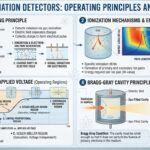

Proportional counters operate within the proportional region (Region III) of the gas-filled detector voltage curve, leveraging internal gas multiplication to bridge the gap between weak primary ionization signals and measurable electronic pulses. Designed to operate at elevated operating voltages (typically around , with exact thresholds varying based on the specific gas medium), these instruments provide exceptional sensitivity, rapid response, and unique radiation energy discrimination capabilities essential for health physics, research, and industrial compliance.
1. Design and Structure of the Proportional Counter
The precise performance, high sensitivity, and spectroscopic capabilities of a proportional counter depend entirely on its specialized physical design and internal structural engineering. Built to maintain an intense electrostatic field gradient, the hardware configuration is meticulously optimized to facilitate the Townsend avalanche process.

The Cylindrical Cathode (Outer Shell): Typically constructed as a rigid outer metallic cylinder made from durable conducting materials such as copper, aluminum, or stainless steel. This outer shell acts as the negative electrode (cathode) and forms the sealed boundary of the detector active volume.
The Fine Anode Wire: Suspended precisely along the central axis of the cylinder is a microscopic, high-purity tungsten or stainless-steel wire acting as the positive electrode (anode). The radius of this wire () is exceptionally small, typically ranging from to micrometers.
Insulating End-Plugs: High-grade ceramic or Teflon insulators secure the central anode wire at both ends, ensuring it remains perfectly centered without touching the cathode wall while maintaining complete electrical isolation.
Entrance Window: For detectors designed to measure low-penetrating radiation (such as alpha or soft beta particles), a thin, low-density window—constructed from materials like mica, beryllium, or aluminized mylar—is built into the housing to allow radiation to enter without significant attenuation.
Electrostatic Field Geometry and Radial Design: The defining structural characteristic is its cylindrical electric field geometry. According to electrostatic principles, the electric field strength () at any radial distance () from the center of the cylinder is governed by the equation:
(Where is the applied high operating voltage, is the radius of the central anode wire, and is the radius of the outer cylindrical cathode). Because the anode wire radius () is microscopically small, the electric field intensity increases exponentially as free electrons approach the center. This creates an extremely intense high-gradient “avalanche region” confined strictly to the immediate microscopic vicinity of the anode wire.
2. Gas Medium Selection, Pressure, and Density Dynamics
The performance, quantum detection efficiency, and energy response of a proportional counter depend heavily on its internal fill gas composition and pressure:
Inert and Noble Gases: Inert gases such as nitrogen and argon serve as standard fill media for general applications. For high-energy radiation requiring greater stopping power, heavier noble gases like krypton and xenon are utilized to achieve significantly higher intrinsic efficiencies. Xenon-filled proportional counters provide large surface areas and serve as detector arrays in specialized CT scan configurations.
Alternative and Hydrocarbon Gases: Butane functions as an inexpensive, high-density fill gas option, though it requires frequent replacement due to chemical degradation over extended operational lifespans.
Gas Pressure Effects: Increasing internal gas density through elevated pressure directly enhances the number of gas molecules per unit volume, resulting in a higher quantum detection efficiency for penetrating photons.
Quenching Gas Integration: Because secondary avalanche processes produce ultraviolet photons that can trigger spurious continuous discharges, organic hydrocarbons (such as methane or carbon dioxide) are mixed directly into the fill gas to act as chemical quenching agents.
3. The Townsend Avalanche and Gas Multiplication Factor ()
When ionizing radiation interacts with the fill gas, primary ion pairs are formed. Under the influence of an intense electric field established by a high operating voltage, free electrons accelerate rapidly toward the ultra-fine anode wire.
Secondary Ionization Cascade: As these electrons gain high kinetic energy between successive collisions, they ionize neutral gas molecules, producing secondary events. Approximately to secondary events are produced per initial ionization event, resulting in a gas multiplication factor () that amplifies the collected charge by to times.
Strict Proportionality: Because this secondary ionization cascade remains proportional to the initial ionization, the final collected charge scales linearly with the energy deposited. This core principle gives proportional counters their name and enables their use in pulse-height spectrometry.
4. Operational Modes and Spectroscopic Capabilities
Proportional counters are versatile instruments that operate in specialized modes depending on the application requirements:
Pulse Mode and Spectrometers: They operate in pulse mode or as spectrometers to analyze incoming radiation energies.
Radiation Discrimination: Because output pulse height scales linearly with deposited energy, proportional counters easily distinguish between different radiation types. For instance, heavy, densely ionizing alpha particles deposit massive local energy, creating much larger voltage pulses than weakly penetrating beta particles or gamma photons, allowing precise particle discrimination in mixed radiation fields.
5. Quality Assurance (QA) and Quality Control (QC)
To maintain reliable performance in health physics and laboratory counting rooms, proportional counters undergo rigorous QA/QC procedures:
Plateau Verification: Technicians periodically plot a count-rate versus high-voltage curve to identify the stable “proportional plateau,” ensuring minor voltage drifts do not affect count accuracy.
Energy Calibration: Daily checks using sealed calibration sources (such as Iron-55 or Americium-241) verify that electronic pulse-height channels accurately map to specific radiation energies.
Purity Monitoring: Because trace electronegative impurities (like oxygen or moisture) capture free electrons and disrupt the avalanche, detectors require careful gas management, purity monitoring, and purging routines.
6. Advantages of Proportional Counters
Radiation Energy Discrimination (Pulse-Height Spectroscopy): Unlike detectors that merely count events, proportional counters maintain strict proportionality between the initial energy deposited by radiation and the final electrical pulse amplitude. This allows physicists and health safety officers to distinguish between different types of radiation—such as separating heavily ionizing alpha particles from weakly penetrating beta particles or gamma photons—even when exposed to mixed radiation fields.
High Internal Gain and Sensitivity: Through the Townsend avalanche effect, internal gas multiplication factors () ranging from to amplify the collected charge by hundreds or thousands of times. This massive internal signal boost reduces the instrument’s reliance on external electronic pre-amplification and makes it exceptionally resilient against external electronic noise.
Low-Level Detection Capability: Because of their high internal gain and efficient pulse processing, proportional counters excel at detecting low-energy X-rays, weak beta emitters (such as tritium or carbon-14), and low-intensity contamination that would otherwise be lost in detector noise.
Large Surface Area Adaptability: Proportional counters can be manufactured in large geometries or configured as multi-wire proportional chambers (MWPCs), making them highly adaptable for large-area surface contamination monitors and imaging detector arrays.
7. Limitations and Operational Constraints
Extreme High-Voltage Sensitivity: Because the gas multiplication factor () depends exponentially on the electric field strength near the anode wire, even minor fluctuations or ripples in the high-voltage power supply directly alter pulse height and count rates. This necessitates the use of ultra-stable, highly regulated high-voltage power supplies.
Strict Gas Purity Requirements: Proportional counters are exceptionally sensitive to trace electronegative impurities (such as atmospheric oxygen, water vapor, or carbon dioxide leaks). These impurities capture free electrons before they reach the avalanche region, disrupting the electron cascade and causing erratic detector behavior or signal degradation.
Dead-Time Losses at High Count Rates: Although proportional counters have faster recovery times than Geiger-Muller counters, they are still subject to finite dead time (typically a few microseconds). In intense high-flux radiation fields, coincidence losses and pulse pile-up occur, rendering them inaccurate unless electronic dead-time corrections are applied.
Complex Electronic Requirements: Because output pulse amplitudes carry critical energy information, proportional counters require sophisticated electronic support—including charge-sensitive preamplifiers, linear amplifiers, and multichannel pulse-height analyzers (PHAs)—making them more complex and expensive to operate than simple survey meters.
8. Primary Applications in Health Physics, Research, and Industry
Surface Contamination Monitoring: Widely deployed in nuclear research facilities, hospital hot labs, and radiochemical laboratories as gas-flow proportional counters (using P-10 gas). They serve as standard benchtop frisker probes and hand-foot-clothing monitors to detect alpha and beta contamination on personnel and equipment.
Neutron Detection and Spectroscopy: By filling proportional counters with specialized gases—such as Boron Trifluoride () or Helium-3 ()—or lining the interior walls with boron, these detectors become premier instruments for thermal and fast neutron detection. Neutron interactions produce energetic charged particles that trigger reliable proportional avalanches.
Tritium and Low-Level Environmental Monitoring: Deployed in specialized internal gas-counting configurations to assay low-energy beta emitters like tritium () and carbon-14 () for environmental sampling, geological dating, and biological tracer research.
Computed Tomography (CT) Scanner Arrays: Utilizing high-pressure xenon gas fill configurations, proportional counters provide stable, large-area multi-element detector arrays historically utilized in specialized third-generation medical CT scanner systems to capture transmitted X-ray beam profiles accurately.