
RGU (Retrograde Urethrogram)-
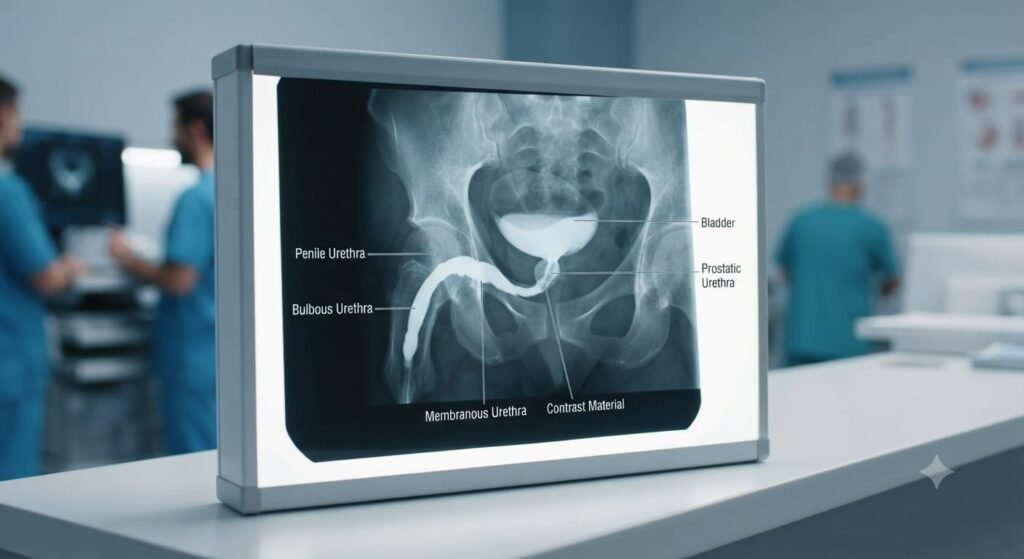
RGU is a specialised X-ray procedure used to analyse the urethra, the last portion of the urinary tract, and search for any anomalies such strictures (narrowing), etc. which cannot be seen on a normal X-ray with using of iodinated contrast media .
Men are often advised to have this test to identify the source of urethral constriction if it is not related to benign (non-cancerous) prostate growth.
One of the most frequent reasons of constriction of the urethra in males is benign enlargement of the prostate gland.
Indication-
- prostate surgery
- urethral obstruction
- dark or bloody urine
- Infection
- Semen with blood in it
- injury from inserting a catheter (tube)
- When there is a suspicion of urethral damage.
The following are some signs of urethral narrowing
- increasing penis swelling
- an ongoing need to urinate
- poor urine flow due to enlargement of the prostate
- tumors in the urethra
- loss of control over the bladder
- Leaking urethra
- sluggish pee stream or urine spraying
- painful urination
- pain in the abdomen.
Contraindications –
- allergy to contrast agents
- acute urinary tract infection and
- Any urethral operations recently carried out
Preparation Of Patient –
- To avoid a bright or blank spot on the diagnostic film, remove any metal objects, including jewellery, hair clips, watches, rings, and other items of a similar kind, from the area of the body being scanned.
- If you are allergic to anything, pregnant, nursing, taking medication, or have any of these conditions, you must let the technician, radiology nurse, and/or doctor know.
- Ask for any history of Diabetes mellitus, Pheochromocytoma, Renal disease, or allergy to drugs and any specific foods.
- Bring all medical history documentation with you (if any).
Keep your ID on you. - Fasting for 4 hours.
- Water may be consumed.
- Do not dehydrate the patient.
- You’ll be positioned on the x-ray table by the medical professional or radiology technician.
- The contrast may be injected before a few x-rays are obtained.
- We’ll use an antiseptic to clean the tip of your penis and get rid of any germs.
- Your urethra will be catheterized by the physician.
Procedure-
In this investigation, a low osmolar contrast agent with a volume of 20 ml and a concentration of 200 to 300 mg per ml may be utilised.
Warming the contrast agent before injecting it into the urethra might lessen the possibility of an external urethral sphincter spasm.
Equal volumes of saline and contrast material (76% urograffin; 1 mL urograffin 76% comprises 0.1 g sodium diatrizoate and 0.66 g meglumine diatrizoate) were administered into the pericatheter area while the patient was in the lateral steep position (between the urethral lumen and the catheter).
After that, the patient was instructed to flex and abduct his right leg at the hip joints while having an anteroposterior pelvic radiograph obtained.
Complications –
The risks of the scan are:
- Injury to the urethra (rarely)
- Urinary tract infection
- Allergic reaction to the contrast dye
- Urethral trauma, and
- Intravasation of contrast medium (contrast going into blood vessels) if excessive pressure is used to overcome a stricture
After Exam Advise –
After the exam, you can get back to your regular activities. For a day or two following the test, you can have some irritability when urinating.
For one to two days, it’s typical to pass some blood in the urine as well.
Within 24 hours of the test, let your doctor know if you experience fever, chills, burning while urinating, or urine that smells bad.