

X-Ray and related equipment
X-rays are a type of electromagnetic radiation that can be used to create images of the interior of objects. X-rays are most commonly used in medical diagnostics, but they are also used in many other industries such as agriculture, manufacturing, and security. In this blog post, we’ll explore the various types of x-ray equipment out there and how they’re being used in different applications. We’ll also look at some of the safety measures that must be taken when working with x-ray machines, as well as some tips on how to get the best results from your x-ray equipment.
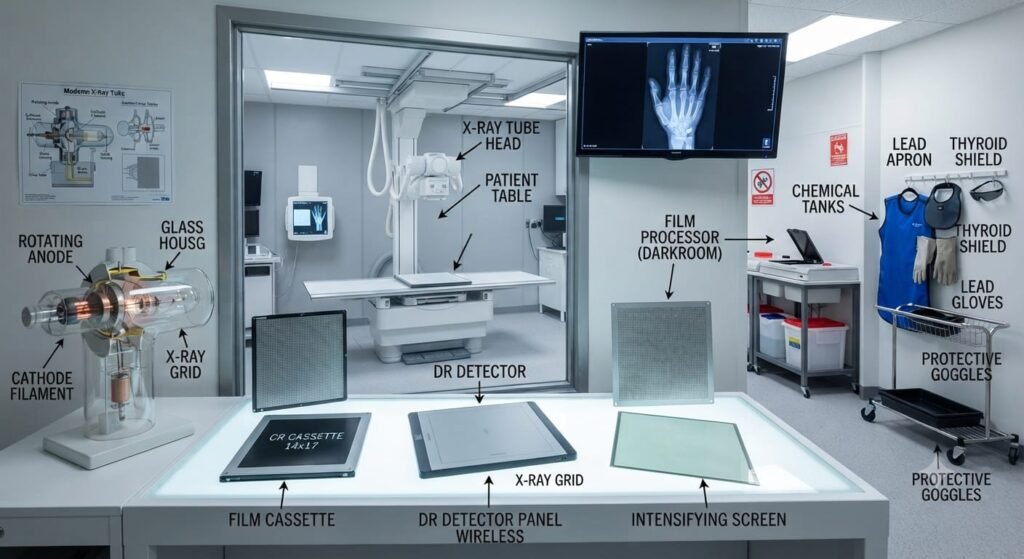
X-Ray tube
An X-ray tube is a vacuum tube that produces X-rays. It is commonly used in X-ray crystallography, medical imaging, and industrial inspection.
The X-ray tube consists of a cathode, which emits electrons, and an anode, which accelerates the electrons and produces X-rays. The cathode is typically a hot filament, while the anode is usually a tungsten target. The accelerating voltage can be up to several million volts.
When the electrons hit the anode, they produce X-rays. The energy of the X-rays depends on the accelerating voltage. Higher voltages result in higher energy X-rays.
X-ray tubes are designed to operate in two modes: continuous wave (CW) mode and pulsed mode. In CW mode, the electron beam is always on and produces a constant stream of X-rays. This mode is typically used for industrial inspection applications. In pulsed mode, the electron beam is turned on and off at high rates (up to 100 kHz). This mode is typically used for medical imaging and X-ray crystallography applications.
X Ray Film
X-ray film is a sensitive material that is used to record images of the structures inside the body. It is made up of two layers of emulsion, one on each side of a clear base. The emulsion is a light-sensitive material that contains silver halide crystals. When the film is exposed to x-rays, the crystals are stimulated and release electrons. These electrons are then collected by an electric current and produce an image on the film.
X-ray film must be handled with care to avoid damage. It should be stored in a cool, dark place and kept away from sources of heat or light. When transporting x-ray film, it should be placed in a lead container to protect it from radiation exposure.
X Ray Cassette
X-Ray Cassettes are the film holders used in conjunction with x-ray machines. There are two types of x-ray cassettes, those for general radiography and those for mammography. X-Ray Cassettes for general radiography are available in a variety of sizes, the most common being 14×17 inches. Mammography x-ray cassettes are much smaller, typically 10×12 inches. Both types of x-ray cassettes have a lead shielding on one side to protect the film from exposure to scatter radiation.
X Ray Detector
An X-ray detector is a device that converts X-rays into an electrical signal. This signal can then be processed to create an image of the object being imaged.
Detector types include film, photographic plate, and charge-coupled device (CCD). Film is the traditional method for producing X-ray images, but it is slowly being replaced by digital detectors. CCDs are used in digital radiography and offer several advantages over film, including lower exposure times and the ability to be reused.
When selecting an X-ray detector, there are a few things to consider, such as desired resolution, sensitivity, and acquisition time. Resolution is determined by the pixel size of the detector, with larger pixels providing lower resolution. Sensitivity refers to the ability of the detector to detect low levels of X-rays, while acquisition time is the amount of time required to collect enough data for an image.
Intensify Screen
There are two main types of X-ray equipment: medical and industrial. Medical X-ray equipment is used to diagnose and treat patients, while industrial X-ray equipment is used to inspect materials for flaws.
Screening procedures for both types of X-ray equipment are similar. The operator places the material on the X-ray table and passes it through an X-ray tube. The tube produces a beam of X-rays that passes through the material being inspected.
Some of the X-rays are absorbed by the material, while others pass through. The patterns produced by the transmitted and absorbed X-rays are recorded on film or a digital detector.
The operator then interprets the resulting image to look for signs of defects or other problems. In some cases, special software is used to enhance the image or automate the interpretation process.
X Ray Grid
By capturing dispersed radiation, the main cause of poor diagnostic quality, X-ray grids provide crisper radiological pictures. A better and more precise image will be produced if an x-ray grid is placed between the x-ray beam and the film or plate.
The main goal of using an X-ray grid is to reduce scatter radiation and improve the contrast and clarity of the medial picture. The item that scatters radiation is thicker than 10 cm in terms of grid standards. The term “Compton scatter radiation” is another name for the scatter radiation.
Dark Room Equipment-
The image is printed onto photographic paper using a darkroom enlarger. It comes with a height-adjustable enlarger head that houses a film holding and the appropriate colour temperature bulb. The picture is focused and projected by an enlarger lens onto an easel that can hold photographic paper of different sizes. Focus finders, timers, and multi-grade filters for changing contrast are among the accessories for darkroom photography that help assure sharp prints. Color filters are used to expose each basic colour for colour printing.
After the film has been exposed, several chemicals are used to develop your prints in shallow trays, and water is then used to wash away any remaining chemical residue. Tongs, tweezers, gloves, and squeegees are additional helpful darkroom supplies for protecting your prints during development.
X Ray Protective Equipment-
The employment of specialised lead-lined protective gear is the most popular method of x-ray shielding. Lead is a highly densely packed metal that is incredibly heavy. Due to its near impenetrability, it excels in attenuating radiation waves. Lead’s drawbacks are its weight and toxicity. However, new lead-free shielding materials that are both lighter to wear and less poisonous have been developed by current metallurgical technology. A good example is the ground-breaking Pb-free attenuation material from Barrier Technologies.
- List of X Ray Protective Equipment
- X Ray Protective Glass
- X Ray Protective Head Shield
- X Ray Protective Thyroid Shield
- X Ray Protective Lead Apron
- X Ray Protective Shoulder Protector
- X Ray Protective Gloves
- X Ray Protective Gonad Shield
- Etc.