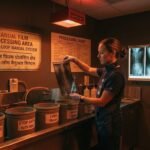
Automatic X Ray Film Processing & How is it different from the manual ?

Automatic X Ray Film Processing –
Before reading automatic x ray film processing , you must read its first part in which Manual X ray Film Processing and Exposure of film / Latent image formation and stage and developer of X ray film processing Manual X Ray Film Processing & Fixer , Washing & Drying are explained in detail.
Automatic X Ray Film Processor –
In the past, x-ray film was created using a manual film processing technique in a darkroom with no white light. Only safelight was used for the film’s development.
An Automatic X Ray Film Processor is a machine made to shift medical X-ray films automatically from one solution to the next during the film developing process, with the exception of inserting a film or cassette.
Primary Subsystems Of Automatic X Ray Film Processor –
Film transport, temperature, circulation, replenishment, drying, and electrical control are the six primary subsystems that are commonly present in automatic film processors, also known as film processing systems. There are various automated film processors, and they may be distinguished by how long it takes for a film to develop (the dry-drop time).
- Film transport
- Temperature
- Circulation
- Replenishment
- Drying
- Electrical control
Some Technical Knowledge About Automatic X Ray Film Processor –
- The term “X-Ray Processor” refers to a device that develops and fixes x-ray films without requiring any interaction from the user between inserting the exposed film and receiving the produced film into the wash tank for collection at the end of the procedure.
- Undeveloped film is fed into the machine in a dark, enclosed space viewable through its protective red perspex cover. A motor-driven “module” then transports the film between two continuous belts via a developer tank. The film is distributed into a similar “module” operating in a separate tank that also houses Fixer.
- Two rod heaters that protrude from the machine’s back wall keep the chemical temperature at 27°C (81°F), heating each chemical tank through a metal sleeve.
- After processing, the film ultimately enters a water wash tank. Retrieving it involves taking the film out of the collection tank.
- Boiling water will harm your machine, so never use it.
A FEW DIFFERENCES BETWEEN AUTOMATIC AND MANUAL PROCESSING-
- Because rollers remove the chemicals, there is no stop bath between developer and fixer.
- High temperatures for CPUs that run automatically. Consequently, many compounds are needed.
- The developer in automated processors was hardened.
- More hardener is included into the fixer solution.
- The daylight-loader eliminates the need for a darkroom.
- The procedure is a “dry to dry” process because of the heating in the automated processor.