
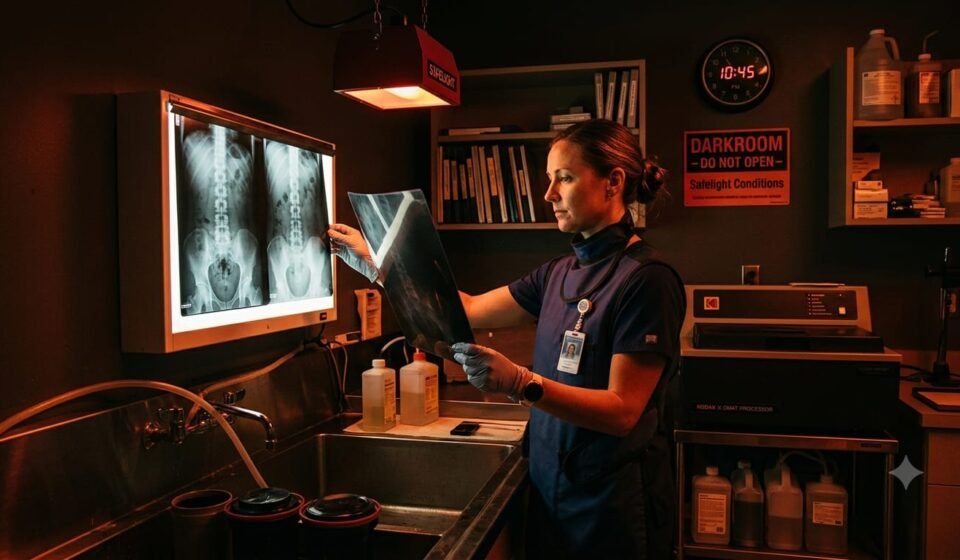
Manual X Ray Film Processing & Wash [stop bath] / Rinsing, Fixer, Washing & Drying

Before reading this post, you must read its first part in which Manual X ray Film Processing and Exposure of film / Latent image formation and stage and developer of X ray film processing are explained in detail.
Wash [stop bath] / Rinsing –
If the developer’s operation is not stopped at the appropriate moment, the silver image grows too thick to fulfil its intended function. Uneven fixation is possible if the film is passed straight from the developer to the fixer.The gelatin emulsion, which is soft and swollen after the film is withdrawn from the developer and contains chemicals, is removed by submerging the film in water. The development reaction is halted, the soluble compounds are eliminated, and the leftover developer’s alkalinity is decreased by washing the film in water. Unexposed silver halide crystals cannot be wiped away because they are not water soluble.
The film has to be rinsed in a bath of fresh, running water for 10 to 15 seconds.
To prevent reticulation, which causes the emulsion layer to expand and contract unevenly, the water’s temperature must be as near as possible to that of the developer and fixer.
If this step were skipped, the alkaline developer that the film kept would quickly neutralise the fixer’s acid.
Brown stains will appear on the radiograph after a few weeks as a result of the fixer’s fixing and hardening activity being compromised.
The film is readily scratched because the emulsion layer (gelatin) is soft when wet.
To prevent fogging, safe lighting must be maintained while the film is moved from the developer to the wash tank, then to the fixing tank.
Squeegy rollers are used in automated processing to remove chemicals, allowing the film to travel directly from the developer solution into the fixer.
Fixer –
1. Fixer Solution: Chemical Composition & Functions
The fixer solution primarily consists of five active components, each performing a specific function:
| Component | Chemical Used | Primary Function |
| Clearing Agent | Ammonium thiosulfate / Sodium thiosulfate (Hypo) | Converts unexposed and undeveloped silver halide crystals into soluble silver complexes and dissolves them out of the emulsion. |
| Acidifier | Acetic acid (dilute) | Neutralizes the alkaline developer carry-over and maintains the necessary acidic pH (4.0–4.5) for optimal fixing action. |
| Hardening Agent | Potassium alum / Aluminium chloride | Hardens and shrinks the swollen gelatin emulsion to prevent physical scratches and abrasions. |
| Preservative | Sodium sulfite | Prevents the oxidation and premature chemical breakdown of the clearing agent. |
| Buffer / Solvent | Boric acid / Purified Water | Stabilizes the solution’s pH balance and acts as a carrier medium to dissolve the chemicals. |
All exposed silver halide crystals have been transformed into metallic silver and bonded to the emulsion by the time an x-ray has been fully produced. Silver crystals that have not been subjected to developing solutions are little impacted. Silver crystals that aren’t exposed or developed are removed by fixer from the film.
A film cannot ever be further exposed once it has been “fixed.” Developer and fixer have very different chemical makes-ups. Fixer is acidic when developer is alkaline. To ensure that no further formation of silver crystals occurs, acetic acid is utilised (otherwise, the grey areas of the film would continue to develop until they were black). The fixation process is made more effective by agitating fixer solutions, which improves the capacity of the fixer’s compounds to be forcefully attached to silver halide crystals.
If the film is being processed manually, the developer solution should be used for X minutes, the fixer for 2 minutes, and the final rinse for 3 minutes. The time-temperature chart decides “X”. Radiographs should be processed in the developer at 68° F for 5 minutes.
The process of wet reading or viewing, which involves removing films from the fixing solution after five minutes, is only permitted in emergency situations. After then, the film must be reinserted into the fixer.
The resulting film will get discoloured after a few months if these undesired silver bromide crystals are not eliminated.
If the film is only partially fixed, it will eventually start to become brown.
Composition of fixer-
The Fixer Solution consists of four fundamental components
- Fixing agent
- Preservative
- Hardening agent
- Acidifier
1. Fixing agent –
- The fixing agent, often referred to as the clearing agent, is composed of ammonium thiosulphate or sodium thiosulphate (hypo).
- Its goal is to completely clean the film emulsion of any unexposed and undeveloped silver halide crystals in order to allow light to flow through the picture captured on the film and enable viewing of the radiographic image on a view box.
- This chemical “clears” the film so that the developer’s black picture can be easily discerned.
2. Preservative –
- The fixer solution also contains sodium sulphite, the same preservative found in the developer solution.
- Preventing the fixing agent’s chemical breakdown is the preservative’s main goal.
- By binding with any oxidised developer that is sent to the fixing solution, it also aids in clearing the film.
3. Hardening agent –
- The fixer solution’s hardening agent is potassium alum, aluminium chloride, etc.
- It compresses and hardens the gelatin in the film emulsion to shield it from scratches and stop it from oxidising.
- It reduces drying time as well. It limits water absorption by reducing emulsion swelling in the final wash, which causes less mechanical damage to the emulsion.
- Any contaminated alkali left behind from the developer are also neutralised.
4. Acidifier –
- Acetic acid or sulfuric acid is the acidifier used in the fixer solution. It serves to balance out the alkaline developer.
- It offers the essential acidic medium for thiosulphate to diffuse into the emulsion.
- In addition, the acidifier creates the acidic environment that the fixing agent needs.
Washing-
The last wash’s goal is to clean the film of any remaining fixer chemicals, such as acid, thiosulfate, and silver salts. All chemical stains from the fixer and development processes are removed or neutralised by a water bath. The x-ray will film turns brown due to insufficient washing & film age and become brittle if any chemical traces are still present on the film.
How well a film is washed depends on the wash water’s temperature, flow, and composition. Below 60°F (16°C), washing often proceeds quite slowly.
The fresh film handed over from the fixer should not contaminate the films since they should be cleaned in batches. If capacity is limited, partially washed film should be pushed in the direction of the intake as new films are added to the wash. While using the same amount of water, the cascade technique of washing produces superior results. Separate the wash tank into two halves (maybe two tanks). Place the fixer’s films at the output area. Move the batch of film to the intake section after a partial wash. The wash in freshwater is now finished.
In the majority of wash cycles, the produced film is placed in a warm water bath. To improve the effectiveness of the water in eliminating chemical residue, it is stirred. The film passes through a set of squeegees to remove extra water right before it leaves the washer and enters the dryer. Films should not be left in the water for too long while washing at temperatures exceeding 85°F (30°C).
Additionally, repeated washing tends to make the emulsion soft, which makes it more susceptible to scratching.
Archiving step-
The washing and drying stages of processing are referred to as the “archiving step” because they help the film be handled and preserved for a long time.
Reticulation-
Reticulation, also known as uneven swelling and shrinking of the emulsion layer, is possible if the temperature differential between developer and/or fixer and water reaches 15 F.
Drying –
Just before the film leaves the processor, the drier removes any extra water from it. The film is dried completely using warm air that is cycled at 120 to 150 degrees F. Extended or excessive head ruins the film.
Most workplaces simply hang their films on a rack in the darkroom above a drip tray made to capture the run-off excess water to dry them. To dry the film, some people use a fan. The films shouldn’t be immediately exposed to the fan’s air. There are cabinet dryers that come with a fan and heating components. If handled improperly, wet films are susceptible to abrasion and scratch damage. If there is airborne dust, dirt can readily embed itself inside the emulsion. Radiographs that are moist should not be removed from their hangers until they are totally dry.
If the processed films are still moist when they are removed, the heating element may have broken down or the temperature control may have been altered. It could also mean that the fixer is depleted (diluted) to the point that it is unable to properly harden the film, or that the developer is oxidised.
Precautions For Drying –
The film should be dried in a setting that is largely free of dust.
Driers for drying the film are offered commercially.
Film drying is crucial because water marks can occasionally produce artefacts.
The processed films need to be correctly recognised, mounted, and transilluminated before being seen.