
The Ultimate Guide to X-Ray Physics: Comprehensive Properties, Generation, and Modern Applications

X-rays are an essential band of the electromagnetic spectrum. Since Wilhelm Conrad Röntgen discovered them in 1895, X-rays have transformed healthcare, material science, and global security. Understanding their fundamental physical, chemical, and biological properties explains how they penetrate solid matter and how to safely control them
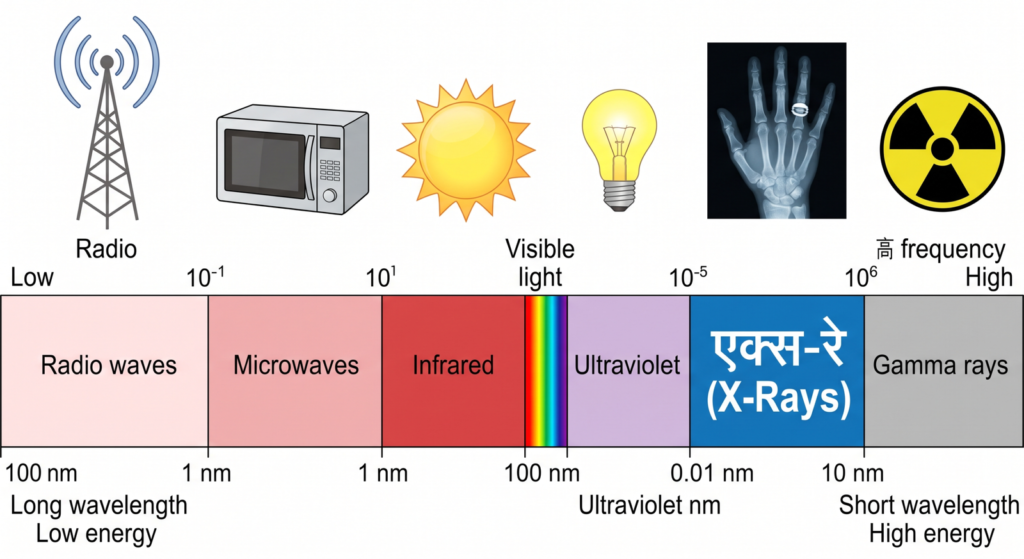
1. Fundamental Electromagnetic Characteristics
- Electromagnetic Nature: X-rays consist of massless energy packets called photons traveling in a vacuum at the speed of light (c≈3×10⁸ m/s).
- Zero Electric Charge: X-ray photons carry no electric charge. Consequently, external electric or magnetic fields cannot deflect or bend an X-ray beam.
- Wave-Particle Duality:
- Wave Behavior: They display wave properties such as diffraction, interference, and polarization at atomic dimensions.
- Particle Behavior: At high energies, they exhibit particle properties through momentum transfer, as seen in the Compton effect and Photoelectric effect.
- Spectrum Position: X-rays sit between ultraviolet radiation and gamma rays. Their wavelengths span 0.01 nm to 10 nm, corresponding to frequencies between 3×10¹⁶ Hz and 3×10¹⁹ Hz.
2. Mechanics of X-Ray Generation
X-rays are generated inside a vacuum tube where high-speed electrons collide with a dense metallic target (typically tungsten or molybdenum).
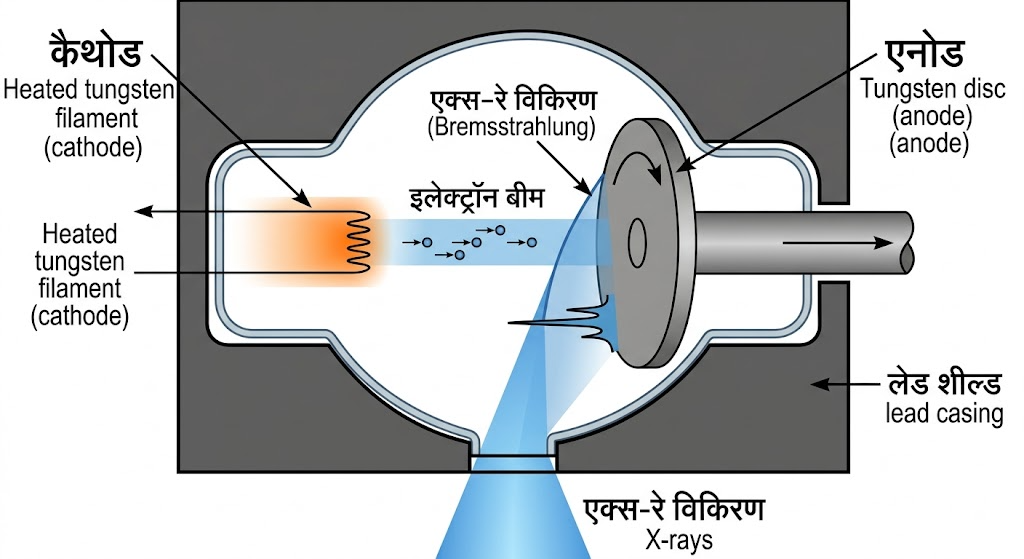
- Continuous Radiation (Bremsstrahlung): When fast-moving electrons pass near heavy target nuclei, the intense electrostatic field slows them down. This loss of kinetic energy is released as continuous X-ray photons.
- Characteristic Radiation: When an incoming electron knocks out an inner-shell electron of the target atom, an electron from a higher shell drops down to fill the gap. This transition emits an X-ray photon with a precise energy characteristic of that specific element.
3. Core Physical Properties & Matter Interactions
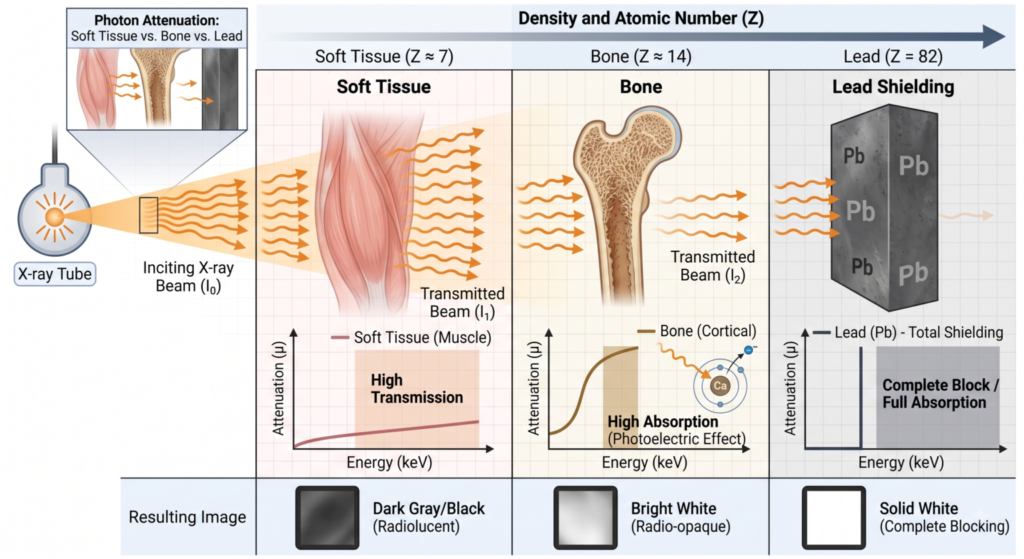
- Penetration & Exponential Attenuation: X-rays penetrate opaque materials. As an X-ray beam travels through matter, its intensity decreases exponentially according to Beer-Lambert’s Law:I=I0e−μx(Where I is final intensity, I0 is initial intensity, μ is the linear attenuation coefficient, and x is material thickness).
- Atomic Number Dependency: Attenuation depends heavily on a material’s atomic number (Z) and density. Materials with high Z numbers (e.g., Lead, Z=82) absorb X-rays far more effectively than low Z elements (e.g., Hydrogen or Carbon in soft human tissue).
- Ionization Capability: X-rays carry enough energy to knock tightly bound electrons out of atoms, creating positive ions and free electrons.
- Fluorescence and Phosphorescence: Striking compounds like zinc sulfide (ZnS) or barium platinocyanide converts invisible X-ray energy directly into visible light.
4. Chemical and Biological Properties
- Photographic Effect: X-rays expose photographic emulsions and digital flat-panel detectors similarly to light, turning exposed silver halide crystals dark.
- Chemical Action: X-ray radiation can break chemical bonds, trigger free radical formation, and catalyze polymerization or color changes in specific solutions.
- Biological Effect:
- Direct Damage: Directly breaks double-stranded DNA chains inside cell nuclei.
- Indirect Damage: Radiolyzes water molecules within cells (H2O→H++OH−), creating free radicals that damage cellular structures.
- Therapeutic Utility: Controlled high doses destroy malignant tumor cells (Radiation Therapy).
5. Detailed Classification: Soft vs. Hard X-Rays
| Property | Soft X-Rays | Hard X-Rays |
|---|---|---|
| Wavelength | 0.1 nm to 10 nm | 0.01 nm to 0.1 nm |
| Photon Energy | 100 eV to 10 keV | 10 keV to 100+ keV |
| Penetration Depth | Low (absorbed by thin air or paper) | High (penetrates dense metals and human tissue) |
| Primary Uses | Surface analysis, soft-tissue microscopy | Radiography, CT scans, industrial inspection |
6. Comprehensive Real-World Applications
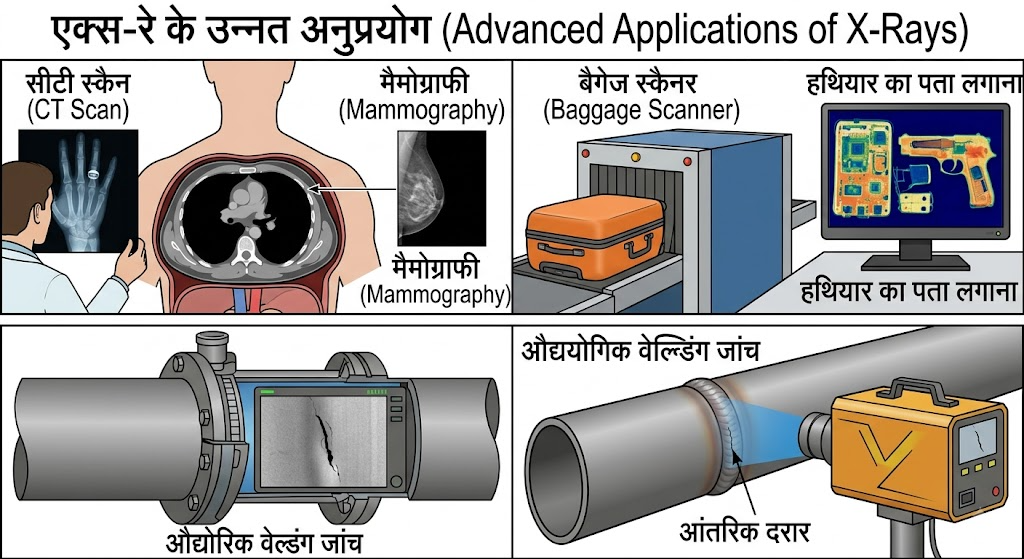
- Medicine & Diagnostics:
- Radiography: Detects bone fractures and dental issues.
- Computed Tomography (CT): Combines multiple cross-sectional X-ray images into detailed 3D models.
- Fluoroscopy: Real-time moving X-ray images for guiding surgical procedures.
- Industrial & Security:
- Non-Destructive Testing (NDT): Inspects internal structural cracks in airplane wings, pipelines, and concrete without damaging the object.
- Cargo & Security Scanners: Identifies concealed weapons, explosives, and contraband at transit hubs.
- Scientific Research:
- X-Ray Crystallography (XRD): Analyzes molecular crystal lattices to determine the 3D structure of complex proteins, DNA, and advanced materials.
- X-Ray Astronomy: Detects high-energy emissions from black holes, neutron stars, and supernova remnants using orbital telescopes.
7. Safety Protocols & Protection Principles
Because X-rays are ionizing radiation, safety protocols follow the ALARA principle (As Low As Reasonably Achievable):
- Time: Minimize the duration of exposure.
- Distance: Increase distance from the radiation source (intensity drops following the inverse-square law: I∝1/r2).
- Shielding: Place dense materials like lead aprons, leaded glass, or concrete barriers between the source and humans.
